Guide No. 7 · The Castle Rolls
Eilean Donan Castle
The single most photographed castle in Scotland spent close to two hundred years as a heap of stones on a tidal island - blown apart by the Royal Navy's own gunpowder, and rebuilt from almost nothing by one family's obsession.
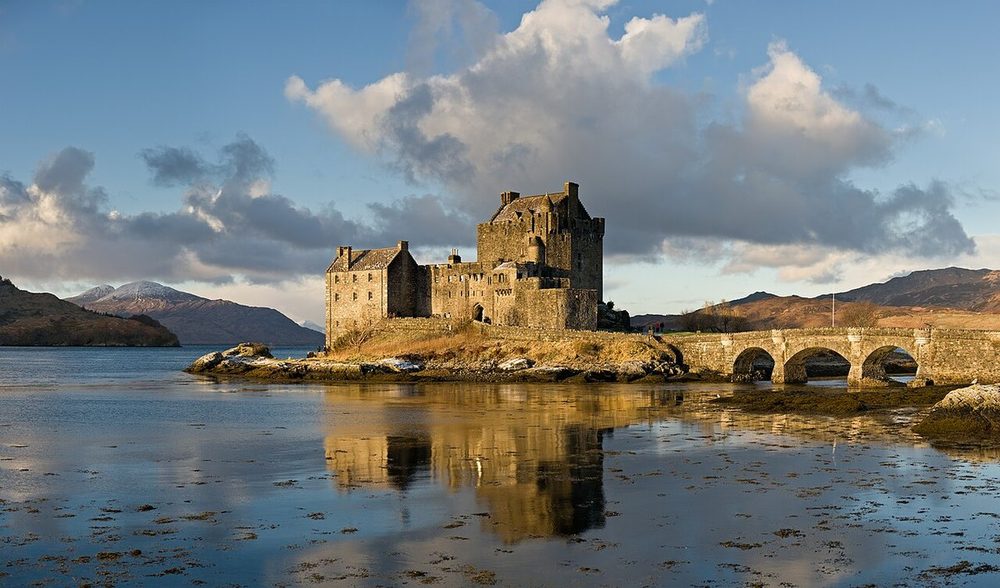
Eilean Donan Castle sits on a small tidal island where three sea lochs meet - Loch Duich, Loch Long and Loch Alsh - in the Scottish Highlands. A fortress has stood here since around the 1230s, built to help guard the coast against Norse raiders. What makes its story unusual isn't the medieval founding, though; it's that the castle everyone photographs today is barely a century old, rebuilt almost from scratch after the original was deliberately blown up by the Royal Navy in 1719.
Blown apart by its own gunpowder
For centuries the castle was held by Clan Mackenzie and administered on their behalf by Clan Macrae as hereditary constables - a relationship that mattered enormously to what happened next. In 1719, in the aftermath of a failed Jacobite uprising backed by Spain, a garrison of around 46 Spanish soldiers occupied the castle in support of the Jacobite cause. Three Royal Navy frigates anchored offshore and bombarded it for two days. When government troops finally went ashore, they discovered a substantial store of Jacobite gunpowder still inside the castle - and used it to finish the job the naval guns had started, blowing the interior apart from within. What was left was a shell, and for the next 200 years, that's all it remained: a ruin on a tidal rock, visited mostly by sheep.
Rebuilt from a dream, not a blueprint
The castle owes its survival to Lieutenant Colonel John MacRae-Gilstrap, a wealthy descendant of the family that had once served as its constables. Starting in 1912, he spent the better part of twenty years and a personal fortune rebuilding Eilean Donan more or less from its footings - guided as much by his clerk of works' own vision of what a Highland castle should look like as by strict archaeological evidence for what had actually stood there before. The result, finished in 1932, is honestly a romantic reconstruction rather than a scholarly restoration, complete with a new stone footbridge connecting the island to the shore. It has never pretended otherwise, and it has become, partly because of that very completeness, one of the most recognisable and most photographed castles anywhere in Scotland - its clean, dramatic silhouette has since turned up in films including Highlander and the James Bond picture The World Is Not Enough.
The video above is the castle's own official promotional film, produced by the trust that runs it today - not an outside history channel, but the people who actually hold the keys, which makes it as close to a primary source on the building as you'll find on YouTube.
Quick answers
Why was Eilean Donan Castle destroyed?
In 1719, during a failed Jacobite uprising backed by Spain, a small garrison of Spanish troops held Eilean Donan in support of the Jacobite cause. Three Royal Navy ships bombarded it, and when government troops went ashore they found a large store of Jacobite gunpowder inside - which they used to blow the castle apart from within. It lay in ruins for the next 200 years.
Is Eilean Donan Castle actually medieval?
The site is genuinely medieval - a fortress has stood on this island since around the 1230s, built to help defend the area against Norse raiders and later held by Clan Mackenzie and its constables, Clan Macrae. But almost everything standing today was rebuilt between 1912 and 1932, after two centuries as a ruin, so what you're looking at is a 20th-century reconstruction on a genuinely 13th-century site.
Who rebuilt Eilean Donan Castle?
Lieutenant Colonel John MacRae-Gilstrap, a wealthy member of the family that had once served as constables of the castle, bought the ruin and spent twenty years and a personal fortune rebuilding it, guided partly by the site's remaining foundations and partly by his clerk of works' own vision of what it should look like - closer to a romantic reimagining than a strict archaeological restoration.
Why does Eilean Donan Castle look familiar even if you've never been?
It's one of the most photographed castles in Scotland, and it has appeared in several major films, including Highlander (1986) and the James Bond film The World Is Not Enough (1999) - so the silhouette of the castle on its small tidal island, footbridge running out to it, is genuinely recognisable even to people who've never set foot in the Highlands.