Guide No. 13 · The Castle Rolls
Windsor Castle
Almost every other castle on this roll is a ruin, a hotel, or a museum. Windsor is the one that never stopped being what it was built to be - a royal fortress, lived in without a break for nearly a thousand years.
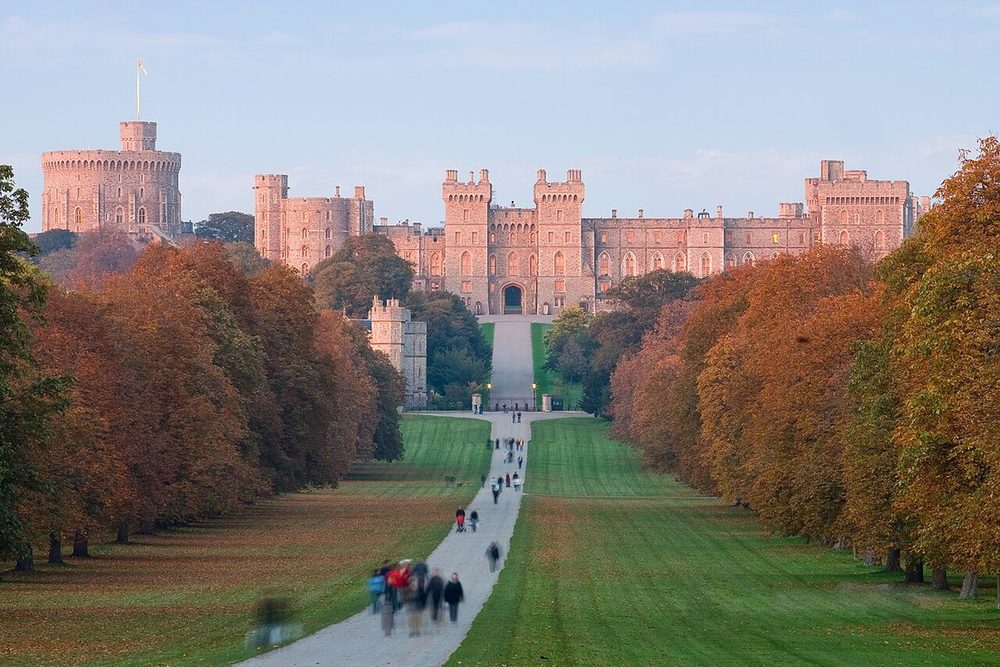
Windsor Castle is the oldest and largest occupied castle in the world - roughly a thousand rooms across some thirteen acres, and a working royal residence continuously since William the Conqueror raised the first timber fortress here shortly after 1066. Almost nothing else in Britain has been in the same use, on the same spot, for that long. Everything else about the place - the Round Tower, St George's Chapel, the George IV state rooms, even the shape of the skyline - is a layer added on top of that first Norman decision about where the Crown needed a stronghold above the Thames.
A motte that never went cold
Windsor began as one of a ring of motte-and-bailey castles William built around London to hold the conquered south-east: a great earthen mound with a timber tower on top, thrown up on a chalk bluff above the river, a day's march west of the city and beside the royal hunting forest that survives as Windsor Great Park. That mound is still the heart of the castle. Henry II replaced the wooden defences with stone in the twelfth century, building the first stone shell keep on the motte - the ancestor of the Round Tower that still dominates the skyline, though its dramatic present height is largely a piece of nineteenth-century theatre, raised by the architect Jeffry Wyatville for George IV to make the castle read as a proper medieval silhouette from a distance. The layout William's mound imposed - a keep in the middle, with a Lower Ward to the west and an Upper Ward to the east - is essentially the plan the castle still keeps today.
The Garter, the chapel, and the fire
In the Lower Ward stands St George's Chapel, one of the finest pieces of late Gothic architecture in England, its Perpendicular fan vaulting begun under Edward IV and finished under Henry VIII. It is the home of the Order of the Garter, the senior order of chivalry in Britain, founded by Edward III in 1348 and still processing through the castle every June. The chapel is also a royal mausoleum: Henry VIII, Charles I and, most recently, Queen Elizabeth II are all buried there. For all its grandeur, Windsor's closest brush with destruction came late. On 20 November 1992 a fire started in the Private Chapel, spread through the north-east corner and burned for around fifteen hours, gutting some of the grandest State Apartments. The five-year restoration that followed was completed in 1997 - and paid for, in good part, by opening Buckingham Palace to paying visitors for the very first time, a modern castle earning the money to repair an older one.
Quick answers
Is Windsor Castle really the oldest and largest occupied castle in the world?
It's widely described that way, and both halves of the claim hold up. William the Conqueror founded it shortly after 1066, and the British monarch has used it as a residence more or less continuously ever since - so it is both the oldest and the largest castle in the world still lived in as a working royal home. It covers around 13 acres and has roughly a thousand rooms.
Why did William the Conqueror build a castle at Windsor?
Windsor was one of a ring of motte-and-bailey castles William threw up around London after 1066 to hold down the newly conquered south-east. Its site was chosen for control rather than comfort: a chalk bluff above the River Thames, guarding a stretch of the river and a day's march west of the city, close to the royal hunting forest that is now Windsor Great Park.
What is the Order of the Garter and what does it have to do with Windsor?
The Order of the Garter is the senior order of chivalry in Britain, founded by Edward III in 1348 and limited to the monarch and a small number of companions. Its spiritual home is St George's Chapel at Windsor, where each knight has an allotted stall, and the annual Garter Day service and procession are still held at the castle every June.
What happened in the 1992 Windsor Castle fire?
On 20 November 1992 a fire broke out in the Private Chapel and spread through the north-east corner of the castle, burning for around fifteen hours and damaging more than a hundred rooms, including several of the grandest State Apartments. No one was killed. The five-year restoration was completed in 1997, and the cost was met in large part by opening Buckingham Palace's State Rooms to paying visitors for the first time.