Guide No. 5 · The Castle Rolls
The Tower of London
Most castles were built to do one job and then, slowly, stopped doing it. The Tower of London is the exception - it has been a fortress, a palace, a zoo, a mint, a prison and a treasury, very often several of those at once, for very nearly a thousand years without a single gap.
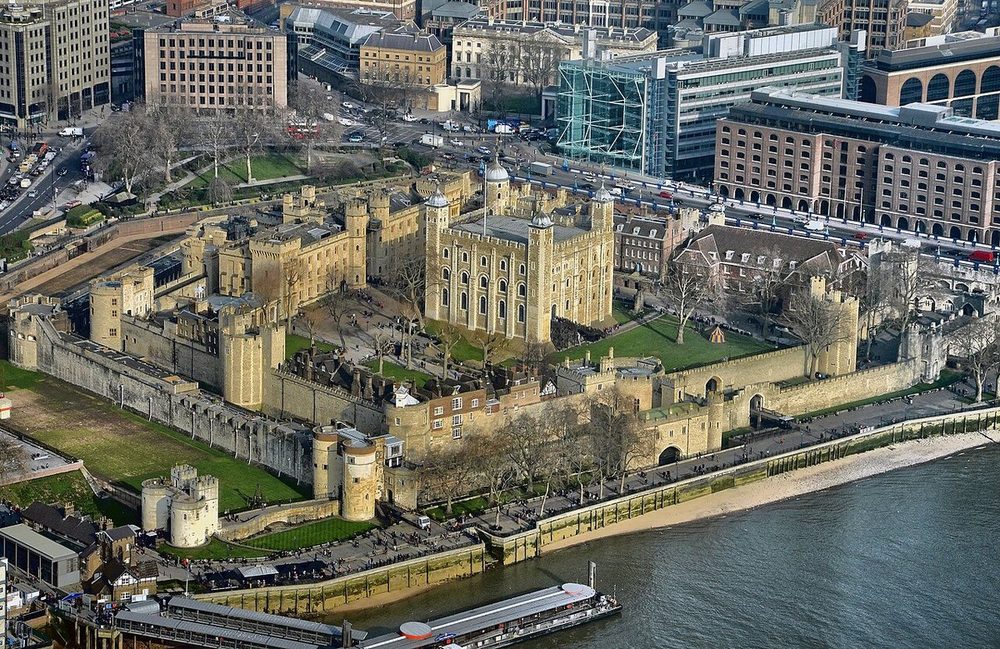
The Tower of London began as a single stone keep, the White Tower, built by William the Conqueror in the 1070s to hold a newly conquered city by force. Everything else - the two rings of curtain wall, the moat, the towers, the eight centuries of additions - grew up around that one building. Unlike almost every other castle on this roll, the Tower never had a quiet retirement as a ruin or a picturesque backdrop. It has stayed continuously, restlessly in use, changing jobs roughly as often as it changed monarchs.
A conqueror's argument in stone
London in 1066 was the largest, richest city William had just taken, and the most dangerous one to hold. He needed a building that did two jobs simultaneously: a genuinely formidable fortress, and a permanent, visible statement that the new regime was not going anywhere. What went up in the 1070s was the White Tower - not a wooden motte-and-bailey thrown up in weeks, like most of William's other castles, but a colossal stone keep, one of the largest buildings in England when it was finished, faced in pale Caen stone shipped over from Normandy specifically because London's own stone wasn't good enough for the statement he wanted to make.
It is worth pausing on how unusual that choice was. Nearly every other Norman lord holding down conquered territory in the 1070s built in earth and timber first, because stone took years and money most of them didn't have. William had both, and spent them, because the Tower wasn't only a garrison - it was propaganda aimed at the city sitting right outside its walls.
From keep to concentric
The White Tower stood mostly alone for over a century. Then, across the 13th century, two kings turned a single keep into something close to the concentric castles that wouldn't become standard practice in Wales for another fifty years. Henry III built a complete curtain wall around the original keep, added towers of his own, and - in the 1240s - had the whole keep limewashed brilliant white, which is where the name White Tower actually comes from. His son, Edward I, went further still: a second, outer curtain wall beyond Henry's, a wide moat flooded from the Thames, and a new water-gate. By 1300 an attacker faced two full rings of defence before ever reaching the original Norman keep at the centre - the same defence-in-depth thinking behind Caerphilly and Beaumaris, worked out independently, a generation earlier, around a building that already existed rather than a fresh plan on open ground.
Everything else it has been
Strip away the fortress and the Tower's job list keeps going. It held the Royal Mint for over 500 years, striking most of England's coinage on site. It was a royal menagerie for six centuries, housing lions, an elephant, and at one point a polar bear that was let into the Thames on a chain to catch its own fish. It stored the national archives. It was, more famously, a prison for high-status captives - not the general population, but people whose rank made a public trial or a quiet disappearance politically awkward - and an execution site for a small, notorious handful of them, including three English queens. Since the 17th century it has also held the Crown Jewels, which is the one job on this list it is still doing today, behind rather more security than a Tudor guard detail.
No other castle on this roll has carried that many simultaneous, unrelated jobs for that long. Most castles have a single peak and a long decline into picturesque ruin. The Tower of London simply never stopped being useful to whoever was in charge, for whatever they currently needed - which is the real reason it's still standing, fully intact, in the middle of one of the world's biggest cities, nine hundred and fifty years after William's masons first started laying Caen stone on the banks of the Thames.
Quick answers
Who built the Tower of London?
William the Conqueror ordered the White Tower - the stone keep at the centre of the complex - built in the 1070s, within a few years of the Norman Conquest, to hold and overawe a city he had just taken by force. It was one of the largest buildings in England when it was finished and remains the oldest part of the Tower today.
Why is it called the White Tower?
Because Henry III had it limewashed white in the 1240s, and the name stuck even after the whitewash itself wore away centuries ago. Today the White Tower refers specifically to the original Norman keep at the centre of the complex, not the wider castle, which is simply called the Tower of London.
Is the Tower of London a concentric castle?
Close to one. Henry III and Edward I spent much of the 13th century adding a full inner curtain wall around the original keep and then a second, outer wall beyond that, complete with a moat - the same defence-in-depth logic that produced the true concentric castles in Wales a generation later. Historians differ on whether the Tower fully qualifies as concentric in the strict textbook sense, but it was clearly built along the same principle.
What has the Tower of London been used for?
Almost everything a fortress can be used for. Beyond its original military role it has served as a royal residence, the Royal Mint, the national arsenal, a menagerie housing lions and, later, a polar bear, a public records office, a prison for high-status captives, an execution site, and - since the 17th century - the strongroom for the Crown Jewels, which it still is today.